Steve’s First Trip to Sturgis
After all the preparation, we’re ready to go. Steve, Bubba, and I leave Columbus in mid-afternoon.
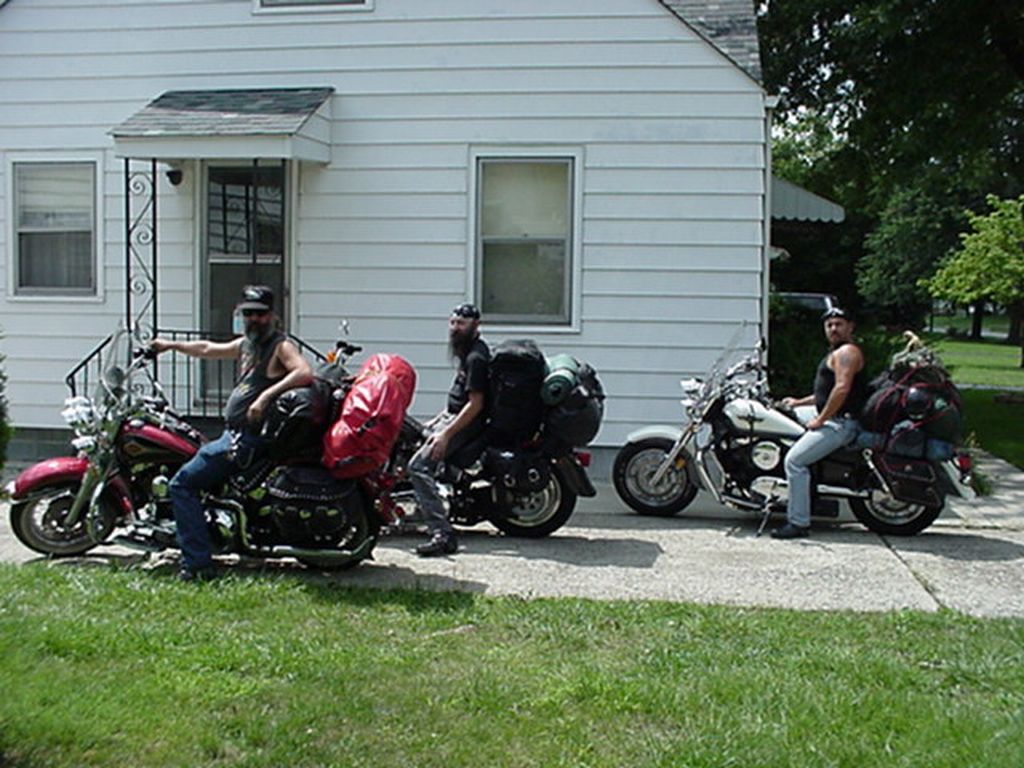
Since this is Steve’s first trip, the goal is to just go about three hours to Indianapolis for the night. It will give him a chance to get used to riding with a loaded bike, and in a group. We discuss more of the subtle details, like the hand signals we’ll use to communicate while on the road. Some ‘people on bikes’ use walkey-talkies in the helmets, but I really prefer the hand signals. As leader, it’s my job to make sure we stop frequently enough for gas or bio breaks, and to keep the group riding safely as a unit by indicating road obstacles, and lane changes. The guy riding in the back has to keep the group together and try to keep cars from getting too close. Other than that, there just isn’t that much to say while going to down the highway. One of the things I enjoy about riding is the solitude, and even while riding in a group, you still have that solitude. I often describe it as “riding alone, together”. At each stop, everyone talks about their experience. It’s amazing how different people notice different details of the same events.
The next day we continue to Allerton Park, in Monticello, Illinois, then on towards Madison, Wisconsin, and the Wisconsin Dells (lakes region). We get onto I-90, with all of the Friday night traffic heading out of Chicago. Traffic is very heavy and moving very fast. Steve is doing a great job keeping up. It gets dark, and we have just under an hour before we reach The Dells. When we arrive, Steve tells us that he lost a contact lens about 30-miles back, and he’s been having a heck of a time trying to see in the dark with one eye. Luckily, the lens stuck to the inside of his goggles, so it wasn’t lost. But he did his first night ride with one eye!
We find a room and find a meal at a nice restaurant. I seemed to remember that the hotel had a $10 discount for guests. The waitress doesn’t know anything about it, but finally gives us the discount. When we return to the room, I read the advertisement, and I realize that it’s a discount at a different restaurant. Oops.
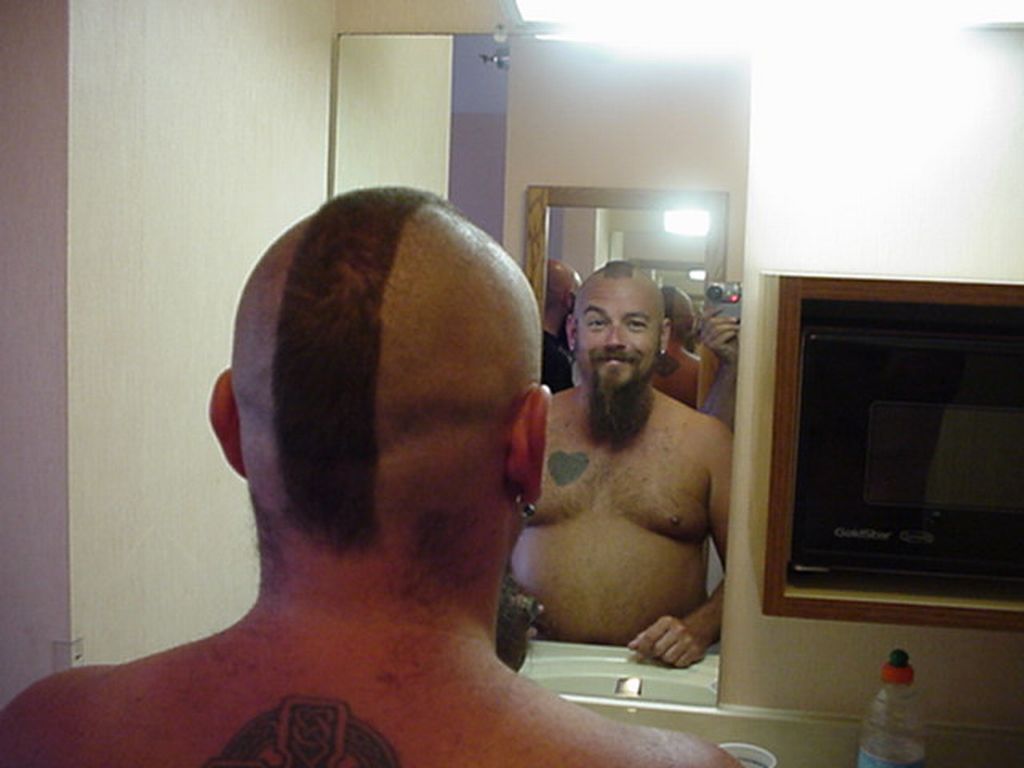
That night in the hotel room, Steve talks Bubba into getting a mohawk haircut. Steve goes out to his bike, returning with a roll of duct tape. He pulls off a length, then puts it on the leg of his jeans, removes it, and repeats a few times. He then takes the strip of less-sticky tape and puts it on Bubba’s head. Steve takes his razor, and cuts all the hair that’s exposed. He pulls off the tape, and Bubba’s got a perfect mohawk! Add that to the long list of uses for duct tape.
The next morning, we look at the Weather Channel, and there is a huge rainstorm covering most of Minnesota (where we are headed). It’s moving quickly towards us. Since Steve hasn’t been on his bike in the rain, I gave him the choice. He decides to ‘go for it’. As we gas up the bikes, I talk with a driver who came from Minnesota. He said it was just misty, and didn’t rain at all. I shout the weather report over to Steve, “Hey, it may not be raining where we are headed!” At just about that moment, the rain arrives. Steve confirms that he’ll ride through it.
“The only time people in cars aren’t jealous of bikers is when it’s raining”, says Bubba.
In good weather, kids often wave at us out their window. Sometimes adults wave, nod, or maybe even smile. More often they just stare at us, or our bikes. Sometimes they look scared and lock the windows, but mostly people just look out their car windows at us with no expression, as if they were watching a wildlife program on television, and study the kind of person who would ride a motorcycle. Sometimes you can tell that they wish they were the one on the bike, riding in the wind and the sun.
But not in the rain. That’s when they stare out the window to see the person who would be crazy enough to ride into the driving rain, with nothing more than a windshield, if the bike even has one at all. These are the times when they are warm, dry, and comfortable in their cars. They don’t wish for the wet rain pelting their face like stones. Quite often they laugh to each other, appreciating the box surrounding them, for once. That’s why I smile and wave to them. Because, even wet, it is just part of the entire experience of riding the bike. It’s the part of the story that we’ll remember. Face it, it is much more difficult to remember the days when the weather was perfect and everything went right. The challenges in life are what we remember, and live on in our stories. The days of great weather don’t always make for interesting stories. Riding a motorcycle, it is easy to accept that there will be days of rain, because we’re also aware of all the days of sun.
About eighty miles down the road, in the steady rain, We stop to warm up and to get gas. I ask Steve how he’s doing on his first rain ride. He’s shivering (he hardly has any body fat to begin with), but says enthusiastically, “This is fun!” His credit card won’t work at the gas pump, so I pay for the gas. He’s on hold with the credit card company as we get some warm food, remove our wet leathers, and dry off. The credit card company noticed that his card was being used at various places near the highway, and put a hold on his card until he could prove his identity. It’s just Steve’s luck to have this happen when he is cold and wet (mycredit card did the same thing at the very next gas stop). Oh well. The rain stops and we see some sun as we cross the Mississippi River.
It turns out to be a beautiful day. Riding across Minnesota on I-90 is much like riding across Iowa: rolling grasslands or farms. Nothing more. We have 350 miles of this terrain to look forward to today (and even more tomorrow)! There’s hardly any traffic on the road, so Bubba gets bored, and starts fooling around. He gets in the passing lane and speeds up, passing Steve and I, all the while making faces and joking around. It helps to pass the time. We change riding positions for the rest of the afternoon, and it’s really funny to see the back of Bubba’s new mohawk. Car passengers seem to notice it, too, and several even point at it.
We spend the night at a motel in Sioux Falls, South Dakota. We’re at the opposite end of the state from Sturgis.
The ride across South Dakota is much like Minnesota, with the exception of one interesting thing every one hundred miles. The rolling grasslands turn into a brilliant yellow sunnflower farm. Unfortunately, it is on the other side of the road, and there is nowhere to stop to get a picture. About a hundred miles later, we crest yet another of the rolling hills only to find a deep valley, with green trees everywhere. The road heads down the hill to a long bridge, crossing the Missouri River. The road climbs the next hill, and when we crest the hill, we are instantly back in the grasslands. It felt very much like a mirage. After the next hundred miles, the grasslands on the south side of the highway simply stop. Gone. Nothing but emptiness for as far as we can see. Then, some tall narrow rocks appear. There is no grass. There is no land. Just the edge of the world.
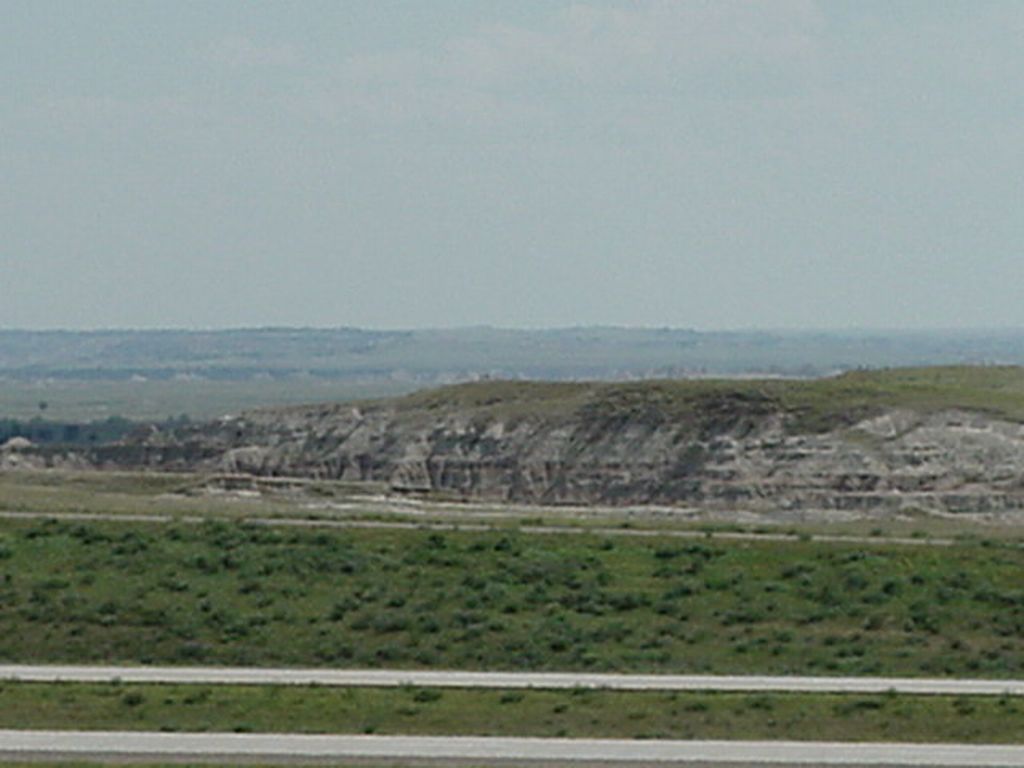
This is the first time since we left home that the scenery isn’t anything like the midwest. This is the Badlands. No wonder the early pioneers gave them this name. There is no way you could haul a wagon over these rocks, and they stretch a huge distance to the south of us. Harsh terrain, with little water, and negligible plant growth. Humans and horses would have a difficult time crossing this.
We ride past the town of Wall, home of the famous tourist trap, Wall Drug. Before we entered South Dakota, we saw the signs advertising Wall Drug. There’s a billboard just about every mile along I-90, reminding drivers to stop for the 5-cent coffee, free water, the dinosaur statue, and whatever else they have to attract tourists. There is not much else of interest in the state, and other than farming, tourism is apparently the top industry. I don’t want to give them any of my money, since it will just go to the third largest industry in South Dakota: making signs advertising Wall Drug.
The terrain starts to change. The hills get taller, with more rocks than grass. Eventually, we can see mountains in the distance. These are the Black Hills. In the 1870’s, gold was discovered in these hills, and they attracted throngs of hopeful millionaires to the region. The world’s largest goldmine operated outside the historic town of Deadwood, finally closing in 2001. The famous Mount Rushmore, carved into busts of four presidents, attracts many tourists each year. Just twenty miles away from that is the massive Crazy Horse sculpture, still under construction (for the next 150 years). There is much more carving to this mountain, since you can take George Washington’s head in Crazy Horse’ nose. Did I say this was massive?
Next: The Sturgis Rally